 0

 English
 简体中文

Content
A storage couch is seating with a usable cavity under the seat: a platform that hinges upward, a drawer that slides out, or a lidded ottoman section that opens from the top. In a 55 square metre apartment that cavity is where the winter duvets, the console cables and the building blocks end up, which is why the mechanism deserves more scrutiny than the fabric swatch. What follows covers how the category breaks down, which numbers on a spec sheet actually predict whether the piece survives year three, and what changes when you buy one unit for a living room instead of two hundred for a container.
What a Storage Couch Is, and What It Is Not
A storage couch is any sofa, sectional or ottoman-based seat whose base volume is enclosed and accessible for storage. The phrase itself is loose. Hidden storage, space saving and multi functional all point at the same three mechanisms, and each one behaves differently once it is in a room.
| Mechanism | How it opens | Typical volume | Fails first |
| Lift-up platform | Seat deck rises on gas struts | 90 to 150 litres on a three seater | Strut pressure, then hinge plates pulling out of soft board |
| Pull-out drawer | Front panel runs on telescopic runners | 30 to 60 litres | Runners bind once the base racks out of square |
| Lidded ottoman | Lid lifts, or flips over to form a tray | 40 to 80 litres | Soft close hinges and lid stays |
A storage couch is a seating unit whose base volume is enclosed and accessible, typically adding 40 to 150 litres of concealed capacity without increasing the floor footprint.
Two things it is not. It is not the same as a cushion lifted off a shallow tray, which is the cheapest construction on the market and the one that disappoints fastest, because the tray is stapled to the frame instead of built into it. And it is not automatically a sofa bed, since a sleeper mechanism and a storage well compete for the same cubic space. Only a purpose built frame carries both without lifting the seat height, so when a listing claims both, check the seat height first. Anything above 46 cm starts to read as a bench rather than a sofa.
The Specs That Decide Whether It Survives Year Three
Three numbers carry most of the risk: seat foam density, the thickness of the load bearing base panel, and the clearance under the front edge.
The strut is the part buyers ask about least and replace most. A lid is matched to a pair of struts by Newton rating, and that rating assumes the lid travels straight. Fit a soft close damper and the strut can be lighter. Skip the damper and the lid slams into the frame twice a day for ten years. At sample stage, four checks settle most of the question:
- Lift the lid with one hand and release it halfway. It should hold position instead of dropping.
- Press the centre of the base panel with the couch assembled. Visible deflection means the panel is too thin or the span is unsupported.
- Look at where the hinge screws land. Metal inserts or hardwood blocks are fine; plain particle board is a repair waiting to happen.
- Check whether the cavity is lined or sealed. Raw board inside a closed box holds dust and takes on odour within a season.
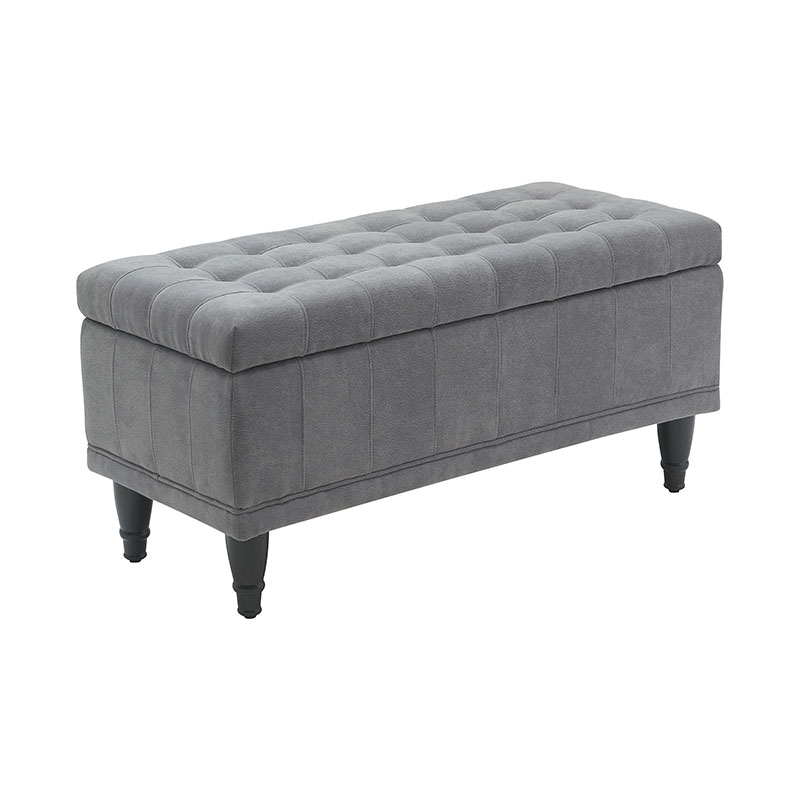
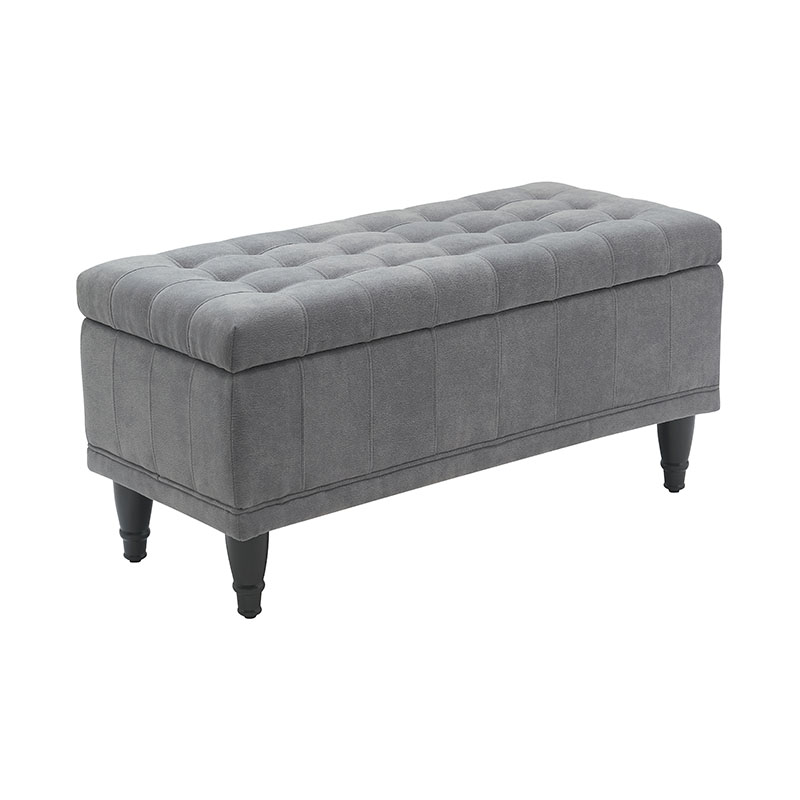 Simple Light Grey Fabric Storage Bench with Padded TopA light grey linen bench with plaid pattern, pull points, and hidden storage, useful at the bed end where lid clearance matters.View Product →
Fitting a Storage Couch to the Room
Clearance decides whether the storage is usable or merely present. A lift-up platform wants roughly 60 cm of open floor in front of it, a drawer wants 50 cm, and a top lid ottoman works in a 25 cm lane because the lid rises rather than travels.
Where it earns its place
- Small living rooms where the sofa is the only large piece of furniture and every litre counts
- Bedrooms that need a bench at the foot of the bed with spare bedding inside
- Entryways where a bench doubles as shoe storage and somewhere to sit
Where it becomes a nuisance
- Against a low window, where a lift-up lid needs rear clearance it does not have
- Households with toddlers, unless the lid has a damper and a soft close hinge
- Anyone storing food, pet treats or damp textiles, because a closed cavity still breathes
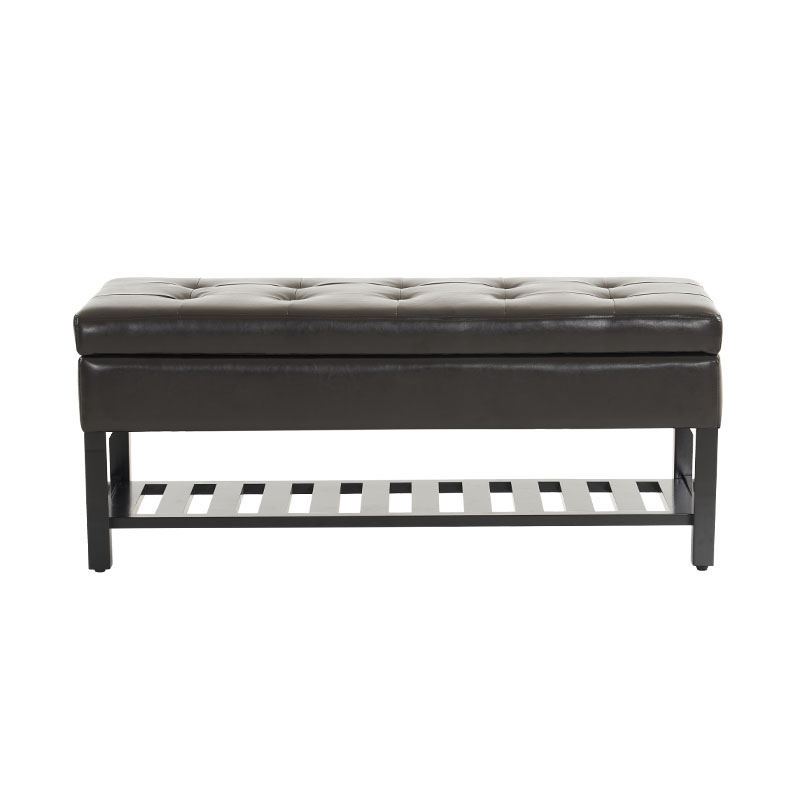 Black Leather Bench with Concealed Shoe StorageA compact black leather bench with a lower shoe compartment for entryways or bed end, where clearance and packaging planning affect usable storage.View Product →
Sourcing Notes for Importers and Retail Buyers
On a container order the cavity is a packaging decision as much as a design one, and the specification has to be locked before the fabric is chosen.
- Fix the mechanism first. A drawer, a strut lid and a fixed bench need different frames, different base panels and different carton depths, so changing the mechanism after sampling resets the tooling.
- Write foam to density and compression set, not to a trade name. High density means nothing across factories; 32 kg/m3 with a stated compression set does.
- Agree the cycle test in writing. Two thousand open and close cycles on the hinge, plus a loaded drop test on the packed carton, catches most of what a showroom sample hides.
- Decide where the cushions travel. Seat cushions are often packed inside the storage well to save carton volume, and a cushion compressed that way for six weeks can arrive with a set it never recovers from.
Our own setup pairs a finished goods plant with a foam plant, so foam specification and upholstery are signed off in the same building (factory and production setup). If the order also includes ottomans or benches, the sizing and material logic overlaps heavily with the seating, and this guide to storage ottomans covers the accessory side of the same brief. Where the brief needs a sleeper rather than a cavity, a foldable platform frame is the usual starting point because the base engineering carries over.
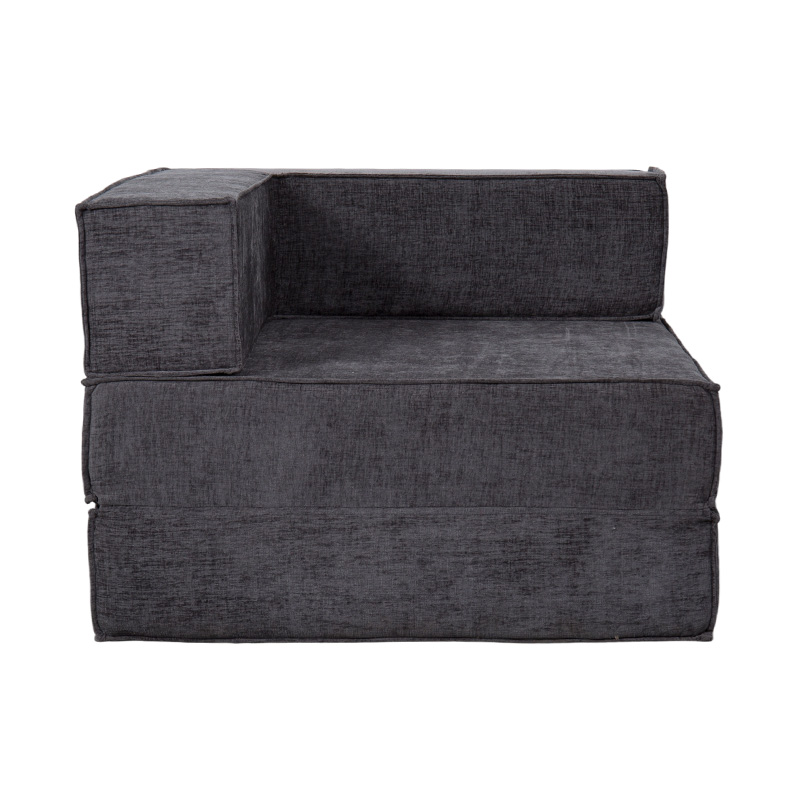
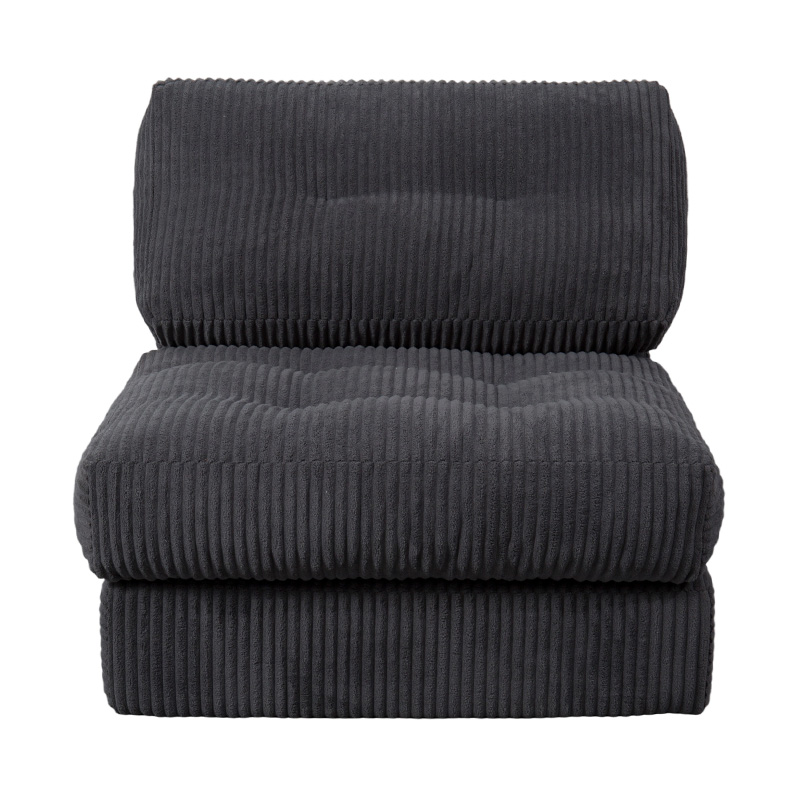 Foldable Full-Foam Sofa Bed in Dark Gray CorduroyA frameless full-foam sofa bed with ergonomic backrest and corduroy upholstery, converting quickly for guests and moving through tight doorways.View Product →
Common Questions About Storage Couches
How much weight will a storage base hold?
A base panel in 12 mm plywood over a supported span handles normal seated use without trouble, and the limit is usually the lid hardware rather than the panel. Ask for the rated load per seat and inspect the hinge fixing instead of trusting a headline number.
Do storage couches hold up with daily use?
Yes, when the mechanism matches the use. A drawer base with cheap runners will fail before a strut lid does, because runners take a lateral load every time the couch is dragged across a rug. Struts, hinges and runners should be treated as replaceable parts.
Is a storage couch the same as a sofa bed?
No. A storage couch keeps its base hollow for objects, while a sofa bed folds or slides a sleeping surface out of that same volume. A few frames do both, but they trade seat height and cavity depth to get there.
Can the compartment be repaired later?
Hardware usually can be, and panels usually cannot. Hinges, struts and runners are standard parts; a base panel that has delaminated or gone out of square normally means a new frame. Confirm spare part availability before the order ships.
Storage seating is one of the few categories where the cheap version and the good version look identical in a photograph. The difference sits in the base panel, the strut rating and the four centimetres of clearance you either measured or did not. Get those three right and the cavity does its job quietly for a decade. Get them wrong and the lid stops closing flush somewhere in the second winter, long after the fabric has stopped being the interesting part.