0

 English
 简体中文

Content
A custom built sectional sofa is made to a drawing instead of chosen from a showroom floor. That single difference decides whether the chaise ends under the window or stops 70 mm short of it, whether the seat still feels firm after three years of nightly use, and whether the corner module clears a 760 mm apartment door.
Retail sectionals move in fixed steps, usually 1800 mm, 2100 mm and 2400 mm, with a corner unit that is what it is. Custom orders work backwards from the room: wall run first, then seat depth, then foam grade, then fabric. The decisions that go wrong are almost never aesthetic. They are dimensional, and they are material.
Below are the inputs that decide the result, and what a factory needs from you before it can quote with confidence.
What Custom Built Actually Means for a Sectional
Custom built means the frame, foam and covers are cut to your specified overall length, seat depth, corner orientation and upholstery, rather than rounded to a catalogue size.
In practice, six variables move:
- Overall length matched to the wall run in 10-20 mm steps instead of 300 mm catalogue jumps.
- Seat depth from 550 mm to 700 mm; 600 mm suits most families, while 650 mm and above is where taller users stop feeling perched.
- Seat height of 400-450 mm to the top of the cushion, which is the number that matters when people stand up.
- Foam grade from 25 kg/m3 to 45 kg/m3, with firmness specified as a separate value.
- Module splits defined by the delivery route first, so each piece clears the door and can be replaced later.
- Arm, leg and seam detail including leg height for robot vacuums and whether cushions are fixed or loose.
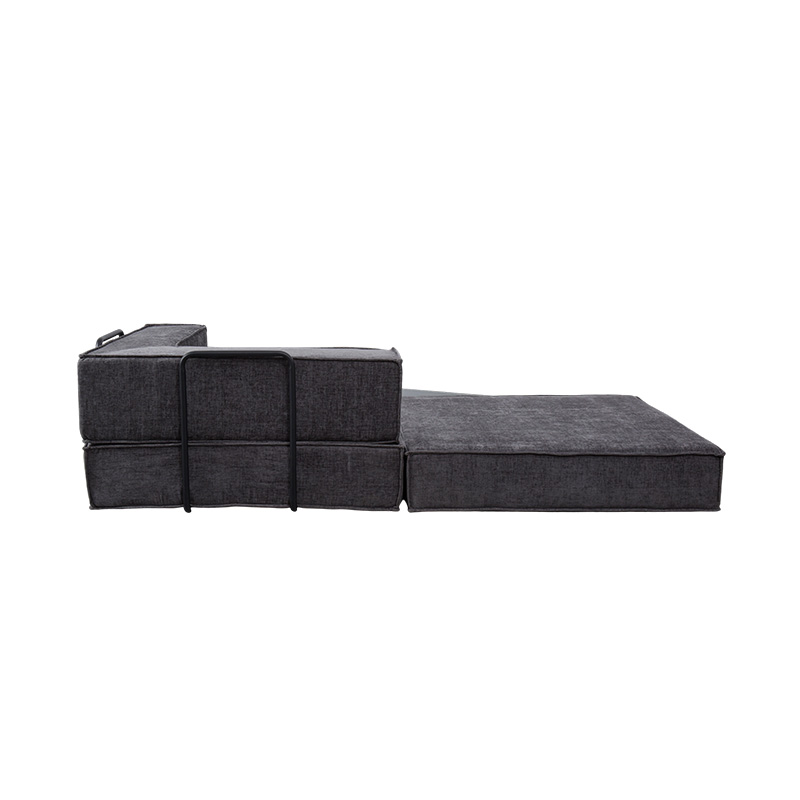 Creative Dark Gray Full-Foam Modular SofaA dark gray full-foam modular sofa whose individual units can be combined and replaced, suiting rentals and flexible living spaces.View Product →
Modular builds carry one commercial argument worth repeating: a single damaged module can be reordered instead of the whole sofa, which matters in rentals, show flats and hospitality projects where one seat takes far more wear than the rest.
Measure the Room, the Doorway and the Turn
Three measurements fail more custom orders than any other: the wall run, the clear width of the narrowest door, and the diagonal of the largest module.
| Check | Target | Why it decides the order |
| Wall run | Within 20 mm of sofa length | Corners are rarely 90 degrees; a gap shows, an overlap does not fit |
| Doorway clear width | 40-60 mm wider than the module | Packaging adds 30-50 mm on each side of the frame |
| Stair or lift diagonal | Greater than the module diagonal | Width alone hides a turn that cannot be made |
| Open-side walkway | 800-900 mm | Below 800 mm the chaise becomes an obstacle |
| Skirting and radiator gap | 20-100 mm behind the backrest | Sets whether the sofa sits flush or stands proud |
Foam Density and Construction Decide Longevity
Seat foam between 35 and 40 kg/m3, with firmness around 30 to 35 ILD, keeps a sectional supportive through daily use; foam below 25 kg/m3 softens within the first year and is the usual reason a cheap sofa looks tired while the fabric still looks new.
Density and firmness are separate specifications. Density controls how long the foam lasts, while ILD controls how it feels on day one. A factory can hit a soft hand-feel with low-density foam, and that is exactly where short-lived sofas come from.
Full-foam construction
- Consistent support across the whole seat
- No springs to break, shift or squeak
- Heavier modules to handle on delivery
- Higher material cost, longer service life
Coil and spring cores
- Lighter weight and a springier feel
- Lower material cost at entry level
- Squeak and sag risk over time
- Harder to repair locally once compressed
Module spacing, seat pitch and foam grades are covered in more depth inside this modular sectional sofa guide.
Fabric, Colour and Wear
Fabric drives returns as much as appearance: 25,000 Martindale cycles or above suits a family living room, 15,000 belongs in a low-traffic guest room, and any rental or contract project should start at 30,000.
- Cream and off-white show dye transfer from denim within weeks; removable covers or a darker seat cushion solve it.
- Corduroy and velvet read lighter or darker by pile direction, so every panel must be cut the same way.
- Charcoal and black collect lint and pet hair; a textured weave hides both better than a flat one.
Layout Logic Before You Commit to a Shape
Draw the walking path first and the seating second: a sectional needs 800-900 mm of clear circulation on its open side, and that single number eliminates more layouts than total floor area does.
- Mark the wall run and every fixed obstruction: doors, radiators, sockets and curtain drop.
- Set the open-side walkway at 800-900 mm and treat it as non-negotiable.
- Choose the corner, left-hand, right-hand or U-shape, based on where people enter the room.
- Place the chaise where feet land without blocking the path, usually the end away from the door.
- Confirm split points against the delivery route, then set seat depth for the tallest regular user.
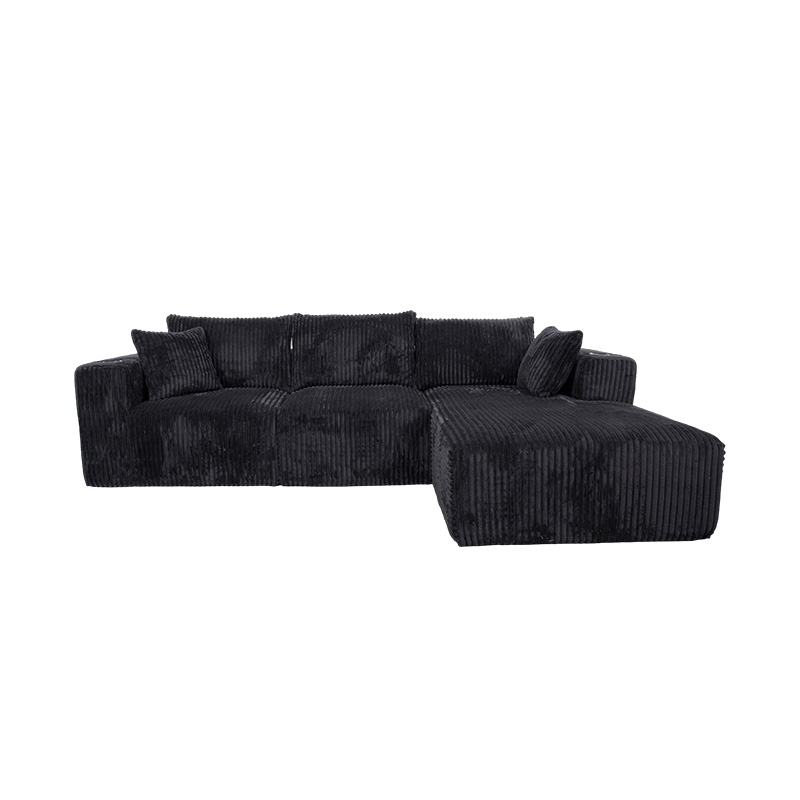 Large Black Corduroy L-Shaped Full-Foam SectionalA black corduroy L-shaped full-foam sectional with cup holders and cushions, available in two sizes for layouts with clear walkways.View Product →
An L-shape in a 4.2 m by 3.6 m room generally works at 2600-2800 mm along the long wall. Below 3.4 m of room width, a two-module build with a movable ottoman keeps the space usable instead of sealing it off.
What to Send the Factory and What Drives the Price
A factory can quote a custom sectional from four inputs: a dimensioned plan, a foam specification, a fabric decision and the quantity per configuration.
Specification pack for a custom sectional quote
- Dimensioned top and front views with overall length, depth and seat height
- Seat and back foam density, firmness, and any fire-retardant requirement
- Fabric reference and Martindale result, or the yardage you will supply
- Module breakdown and packing method per carton
- Quantity per colourway plus destination port and shipment window
Cost sits in set-up rather than materials. Pattern making, foam cutting templates, first-article approval and minimum fabric runs are what a small custom order actually pays for.
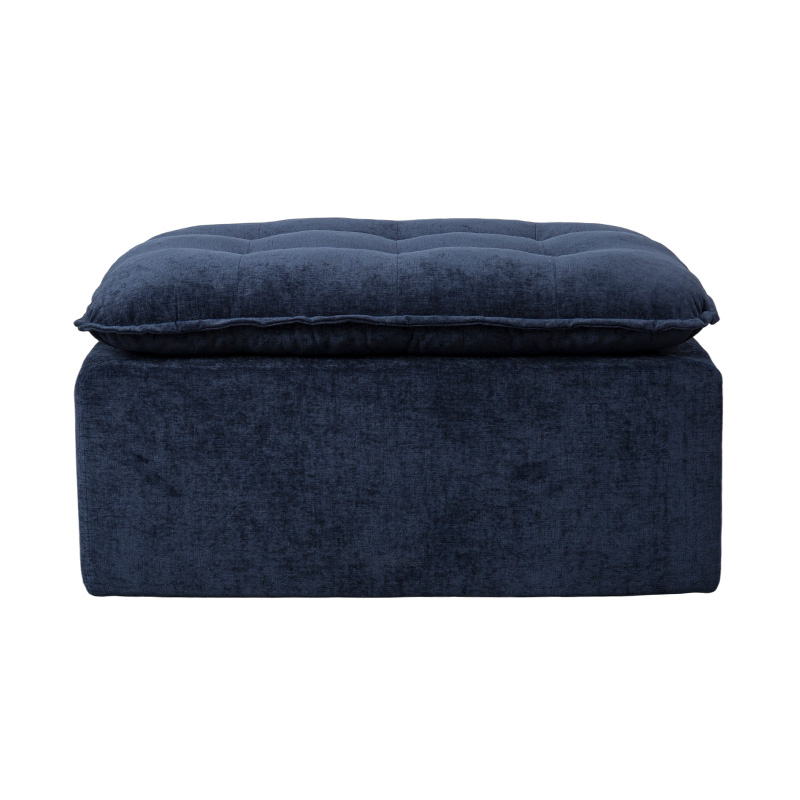 Deep Blue Corduroy Modular Full-Foam Sofa Set with OttomanA deep blue corduroy modular full-foam sofa and ottoman set with D35 foam, suitable for flexible seating and custom small-volume quotes.View Product →
Send the plan, the foam spec and a fabric reference through our contact page so the quote is built on real numbers rather than a catalogue size.
Frequently Asked Questions
Most custom sectional questions come down to four things: timeline, price premium, matching an existing fabric, and how to verify foam before committing.
How long does a custom built sectional sofa take?
Typically 7 to 15 days for a sample or first article and 25 to 40 days for production, before freight. Fabric sourcing is the usual delay: customer's own material adds transport time, and a dye lot that has to be woven can add two to three weeks.
Is a custom sectional more expensive than a stock one?
Yes, usually 10 to 25 per cent on a single unit, because pattern making and first-article approval are one-off costs. The gap narrows quickly with volume: at ten units per configuration, the set-up cost per sofa becomes small.
Can I match an existing fabric or sofa?
Often yes. Send a 200 mm square of the original fabric for a mill match and expect slight dye-lot variance. If an exact match is unavailable, match the texture and abrasion rating rather than chasing a flat colour.
How do I check foam quality before ordering?
Ask for the density in kg/m3 and the compression set figure, then press a 100 mm sample with your thumb for ten seconds. Good seat foam recovers at once; foam that stays compressed will do the same under a person within a year.