 0
0

 English
 简体中文
简体中文

Content
- 1 Modular, Custom, or Both: The Terms Buyers Mix Up
- 2 Measure the Room and the Delivery Path First
- 3 Foam Density Is the Decision You Cannot Reverse
- 4 Upholstery: Pick Fabric by Household, Not by Photo
- 5 Configurations That Earn Their Floor Space
- 6 Samples, Lead Times and What to Fix Before Cutting
- 7 Where Buyers Overspend on a Custom Modular Couch
Most custom modular couch projects start with a number that no catalog can match: a 3.42 m living room wall with a radiator on one end, a 78 cm stairwell turn, or a freight lift that caps crate length at 2.2 m. Standard three-seaters are built around one fixed width, so when your room is not that width the sofa either floats away from the wall or blocks the balcony door.
The workable answer is not a bigger catalog, it is a module grid you define before anyone cuts foam. Lock the seat count and the corner position first, choose the fabric second, and specify foam density third. Every later decision, from the shop drawing to the container loading plan, follows from those three choices. Get them wrong and no amount of stitching quality will rescue the order.
Modular, Custom, or Both: The Terms Buyers Mix Up
Modular describes the system; custom describes the specification. Buyers often treat the two words as alternatives, and that confusion surfaces in the first technical meeting as a mismatch between the drawing and the quotation.
A modular couch is a set of units that share one frame height, one seat platform and one connector, so any seat can be swapped for a chaise, a corner or a backless ottoman. A custom couch means at least one variable is built to your number: overall length, seat depth, arm width, foam grade, fabric, stitching, leg profile or carton size.
Three Levels of Customization
- Configurable standard: you choose the arrangement and fabric from an existing module grid. No tooling change, shortest lead time, lowest risk.
- Modified standard: overall length adjusted by 50 to 150 mm, arm width changed, legs swapped or a storage lid added. Usually possible inside the frame's adjustment range.
- Full custom: new frame, different corner angle, unusual seat depth or a dimension driven by a shipping container. This route needs a prototype before mass production.
Knowing which level you actually need is the fastest way to control both cost and schedule.
| Module type | Typical width | Typical depth | Typical seat height | Planning note |
|---|---|---|---|---|
| Armless single seat | 700–900 mm | 950–1,050 mm | 400–450 mm | Repeatable unit; add as many as the wall allows |
| Corner unit | 900–1,100 mm | 900–1,100 mm | 400–450 mm | Square or 45-degree cut changes the footprint |
| Chaise or ottoman | 700–1,000 mm | 1,500–1,700 mm | 400–450 mm | Leave 150 mm free at the open end |
| Arm end | +150–250 mm | Same as seat | 550–650 mm arm height | Each end unit adds width to the total run |
| Sofa-bed module | 1,400–2,000 mm | 950–1,050 mm closed | 400–450 mm | Confirm mechanism clearance when open |
Measure the Room and the Delivery Path First
The most common cause of a returned modular order is not the sofa, it is the doorway. A configuration that fits the wall perfectly can still fail at the stairwell, and by then the foam has already been cut.
- Measure the wall at three points and use the smallest figure, not the average.
- Subtract 80 to 120 mm for skirting boards and curtain stack, plus clearance if a radiator sits at one end.
- Walk the delivery path with a tape: door width of at least 750 mm, corridor turns, lift interior and stairwell diagonal.
- Choose overall depth by use. Around 900 to 950 mm suits upright sitting; 1,000 to 1,050 mm suits lounging with a laptop.
- Tape the footprint on the floor and live with it for two days before signing the drawing.
Allow a production tolerance of roughly 10 to 15 mm across a 3 m run. Fabric build-up and foam recovery both move the final number slightly, so a supplier who quotes a length to the millimetre without mentioning tolerance is telling you something about their drawing process.
Foam Density Is the Decision You Cannot Reverse
If you only scrutinize one specification, make it this one. Covers can be re-sewn, legs can be replaced and cushions can be refilled, but the seat core decides whether the couch still feels like a couch after three years of daily use.
On full-foam construction there are no springs to share the load, so the seat block carries everything. Practical ranges are 28 to 35 kg/m³ for seat cores and 20 to 25 kg/m³ for back cushions. Foam under about 25 kg/m³ feels generous in the showroom and then loses height within roughly 18 months of daily sitting, which is exactly when the warranty conversation starts.
Two data points are worth requesting before you commit: compression set and dynamic fatigue results from the foam supplier. These show how much thickness the block loses under repeated loading, and they are far more informative than a hand-squeeze test. Because we press our own foam in a dedicated plant next to the finished-goods factory, density can be held inside a stated band instead of drifting with whatever arrives that month, and modified standard orders can be tuned to a firmer or softer core without changing the module grid.
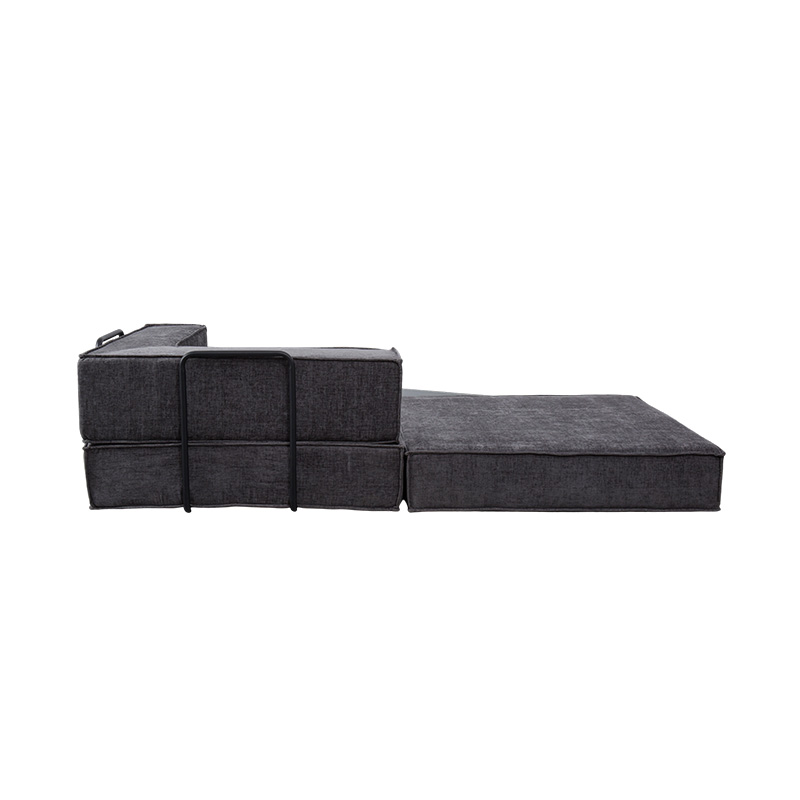 Creative Modular Sofa in Dark Gray Fabric, Freely Combinable and Multi-Functional Full-FoaDimensions: W98cm × D100cm × H70cm Foam: D28/60 Fabric: ChenilleView Product →
Firmness and density are different variables, so separate them in the brief. A 32 kg/m³ core can still be built soft, and asking for a specific density with a seat-feel reference sample is far more reliable than asking for "medium firm" in an email.
Upholstery: Pick Fabric by Household, Not by Photo
Fabric photographs travel badly. Pile direction, dye lot and lighting change what arrives, so the specification should be written in test numbers rather than in adjectives.
- Martindale abrasion: roughly 20,000 to 25,000 rubs for light domestic use, 30,000 and above for a family living room, 50,000 for heavy or contract use.
- Pile fabrics such as corduroy and velvet show hand marks and shading. Cutting all covers from one dye lot matters more than the pile height.
- Chenille and jacquard weave hide everyday wear well; check the pilling grade if pets are in the house.
- Faux leather wipes clean quickly, but low-grade PU can flake in humid climates within three to five years. Ask about hydrolysis resistance and backing quality.
- Colorfastness of grade 4 or better to light, and 3 to 4 to wet and dry rubbing, is a reasonable floor for a couch that will sit near a window.
- Removable covers should be tested for shrinkage after three washes before you approve the order.
For a modular couch, order at least one extra seat cover in the same dye lot. A single replacement panel pulled two years later will never match, and a modular system is only flexible if every unit still looks like it belongs to the same set.
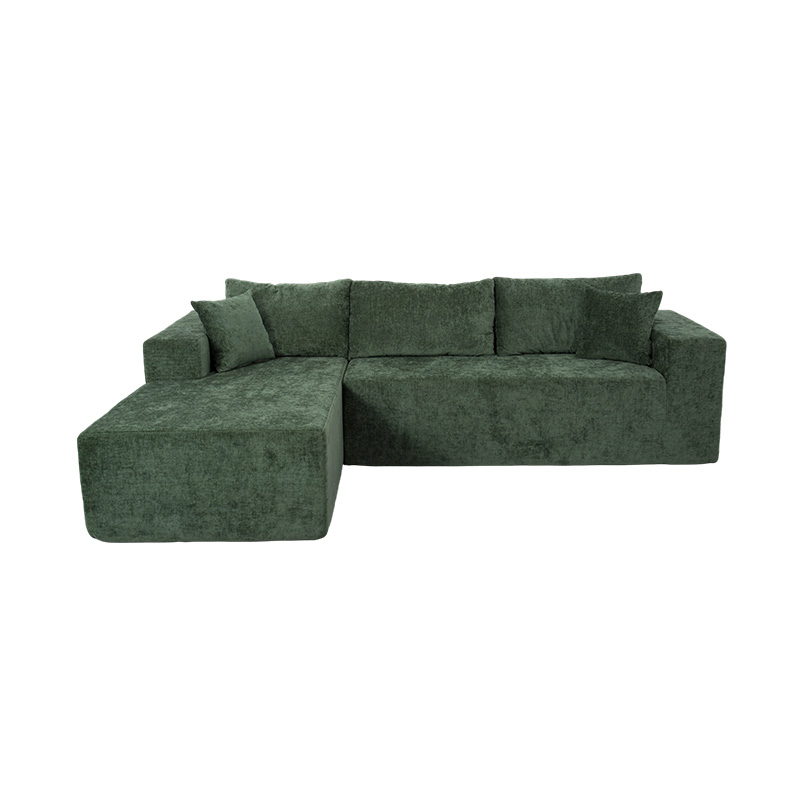 Modular L-Shaped Corner Sofa in Emerald Green Velvet with Multiple CushionsDimensions: W262cm × D175cm × H82.5cm Foam: D35/60 Fabric: ChenilleView Product →
Configurations That Earn Their Floor Space
An L-shaped arrangement with a chaise is the workhorse for rooms between 2.6 m and 3.2 m wide: it seats four to five people while leaving a walkway on the open side. A U-shaped or island layout needs roughly 900 mm of circulation on both long sides, which rules it out in most apartments under 25 m².
Backless ottoman units are the most useful custom addition. They slide along the open end of an L, double as storage, and can be pushed out of the way when the room needs to change function. A transformable module that folds into a bed is worth the extra mechanism cost only if guests actually stay over; otherwise the same floor space buys more seating as a fixed chaise.
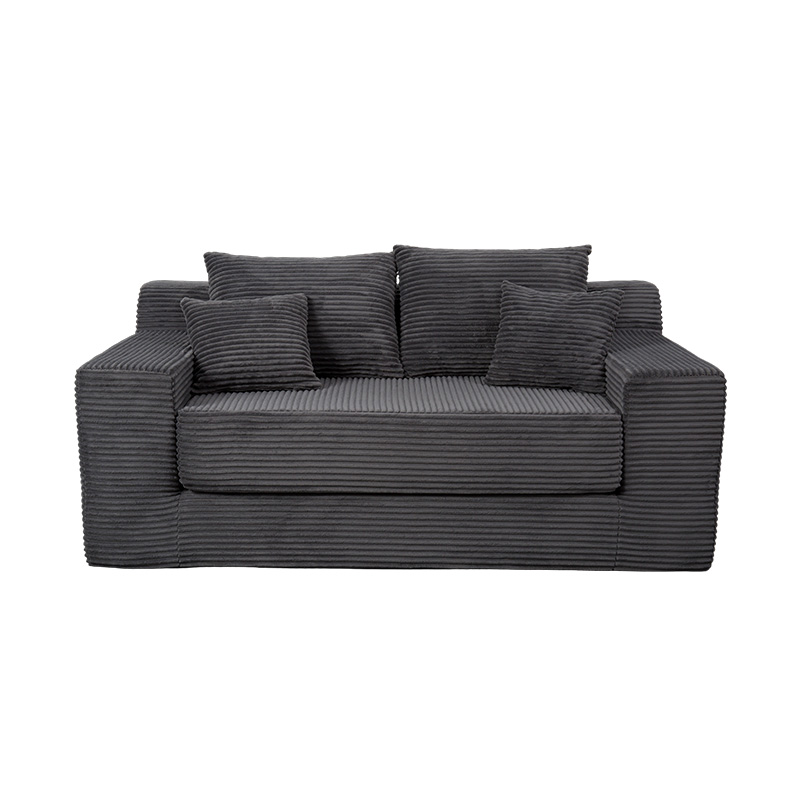 Transformable Modular Sofa Bed in Dark Gray Corduroy with Multiple CushionsDimensions: W172cm × D98.5cm × H85cm / W172cm × D162cm × H72cm Foam: D30/60 Fabric: CorduroyView Product →
Samples, Lead Times and What to Fix Before Cutting
Custom work fails on paperwork far more often than on craftsmanship. Approve a drawing, then a physical sample, then start production. Skipping the middle step is the expensive shortcut.
- Shop drawing approval: three to five working days. Sign off overall dimensions, foam density, stitching, leg profile, label and carton size.
- Pre-production sample: ten to fifteen days for one seat module built from production foam and the actual fabric lot being cut.
- Mass production: twenty-five to forty days after deposit and sample approval, depending on fabric availability.
- Loading check: a 40HQ container typically holds 20 to 28 m³ of packed modular units. Vacuum compression saves volume but velvet and pile fabrics need recovery time and may hold creases.
- Quality points to list on the inspection form: frame joints, connector alignment between modules, zipper function, seam straightness, carton drop test.
Minimum order quantity is normally counted per fabric per model rather than per container. Spreading a single order across five colorways multiplies the minimum, so narrow the palette early. Buyers who want a design developed around their own layout rather than a catalog arrangement can review our manufacturer-direct custom designs for a sense of how those briefs are usually structured.
Where Buyers Overspend on a Custom Modular Couch
Cost usually hides in four places, and only one of them is the foam.
- Over-specified foam density for a guest room or a low-traffic office, where 28 kg/m³ would perform exactly as well as 38 kg/m³.
- Too many fabric colorways inside a single order, which raises the minimum and splits the dye lot.
- Decorative details that slow the line: contrast piping, hand-stitched tufting and multiple panel seams per seat.
- Non-standard seat depths that require new cutting dies and a fresh prototype cycle.
- Air freight for a single sample when a consolidated shipment would have arrived two weeks later at a fraction of the cost.
Each of these is a legitimate choice; the problem is paying for all of them at once on a first order.
Define the module grid, then the foam, then the fabric, and put the dimensions on a signed drawing before a single block is cut. That sequence controls cost, schedule and the fit of the finished couch better than any specification sheet on its own. With more than fifteen years of export production and two plants covering finished goods and foam, we build modular and full-foam pieces to order rather than to a fixed catalog, and you can browse the full-foam sofa collection to see the module types we produce most often or call +86-0563-4630168 to discuss a layout.