 0
0

 English
 简体中文
简体中文

Content
A fixed-frame sectional looks like a safe purchase until delivery day, when a 2.9-meter body jams against the stairwell landing or refuses to turn inside the elevator car. That single moment explains most of the demand for modular sofas: seating that ships in boxes as independent modules and connects only after it is inside the room. The practical conclusion comes first. A modular sofa is worth its premium if you expect to move home within a few years, if the narrowest door or stairwell on the delivery path is under about 80 centimeters, or if you want one purchase to serve as living room seating, guest bed, and reading corner at different times. If your floor plan is settled and you never rearrange, a fixed frame will usually cost less per seat and feel marginally more solid.
What Actually Makes a Sofa Modular
Many product listings use the term loosely, so it is worth defining it before comparing prices. In a true modular sofa, every seat is a structurally independent unit with its own frame, foam, and legs. Modules join through connectors such as steel brackets, locking latches, hook-and-loop strips, or zippered skirts, so an arrangement can be pulled apart and rebuilt without tools. A conventional sectional is the opposite: one continuous frame cut into an L-shape, which is exactly why it can never pass a narrow hallway in pieces.
Most modular ranges are assembled from a small vocabulary of module types:
- Armless seat module, the base unit, usually 80 to 100 centimeters wide
- Corner module, which creates the 90-degree turn of an L-shaped layout
- Chaise or open-end module that extends one side for legroom
- Ottoman module, usable as extra seating, a footrest, or a separate piece in another room
- Convertible module that folds or pulls flat into a bed surface in transformable designs
This vocabulary has commercial weight. Suppliers price per module, so the number and type of modules you select drives the final invoice, not the general look of the sofa.
Where a Modular Sofa Earns Its Price
The strongest arguments are logistical and practical rather than decorative:
- Access. Each module typically weighs 25 to 40 kilograms and ships boxed, so a modular set reaches basements, attics, and apartments with tight stair turns that a one-piece sectional cannot clear.
- Moving house. The same modules pack back into cartons, which protects both the sofa and the walls of the next home.
- Layout changes. An L-shape can become two straight sofas for a conversation zone, then rejoin when the room is replanned.
- Staged spending. Order three modules now, add a corner and a chaise next year, and avoid replacing the whole sofa as needs grow.
- Changing households. One set can split between a living room and a study when family arrangements evolve.
None of these benefits apply to a fixed frame, and that is why modular construction commonly carries a premium of roughly 15 to 30 percent over a comparable fixed sectional. You are paying for the connectors, the individual frames, and the engineering that lets them separate and rejoin cleanly for years.
The Trade-Offs to Weigh Before Ordering
An honest comparison includes the disadvantages, because they are real and deserve a place in the budget:
- Seams between seats. Every module boundary introduces a visible joint and a small gap, and a few millimeters of height difference between adjacent modules falls within normal manufacturing tolerance. If perfectly continuous cushion lines matter to you, check this in person before ordering.
- Connection quality. Cheap plastic clips loosen after repeated rearranging and let modules drift apart in daily use. Steel brackets and locking latches hold alignment far longer.
- Per-seat cost. The same number of seats costs more than a fixed frame of equal size, as noted above.
- Individual seat flex. Because each seat rests on its own frame, occupants notice slight independent movement that a single bench seat does not produce.
These are manageable issues rather than reasons to avoid the category, provided the specifications behind them are confirmed before payment. The next section lists exactly what to check.
How to Evaluate a Modular Sofa Before You Buy
Specifications separate a sofa that lasts eight years from one that sags in three. Ask any supplier to confirm the figures below in writing, because they determine both long-term comfort and how well modules stay level over time.
| Checkpoint | Reasonable benchmark | Why it matters |
|---|---|---|
| Seat foam density | 30 to 35 kg per cubic meter or higher, ideally high-resilience foam | Low-density foam flattens first in the seats that get used most |
| Connection hardware | Steel brackets or locking latches, not bare plastic clips | Keeps modules aligned through repeated reconfiguration |
| Seat dimensions | Height of 40 to 45 cm, depth of 55 to 65 cm per module | Consistent sizing keeps adjacent modules level in any layout |
| Cover fabric | Zip-off washable covers with abrasion resistance of 25,000 Martindale cycles or more for daily family use | Individual washable covers are the main maintenance advantage of the design |
| Module weight | Roughly 25 to 40 kg per seat module | Light enough to carry alone, heavy enough to indicate a solid frame |
Two further habits protect the purchase. Order fabric swatches and judge them on your own floor under your own lighting, because corduroy, velvet, chenille, and linen wear very differently. Then ask specifically what the warranty covers on connectors and frames, not only on foam, since the connectors are the parts that work hardest in this category.
Matching Configurations to Real Rooms
Specifications only matter once they serve a layout, and three scenarios cover most buyers.
Small apartments and studio flats
Two or three armless modules plus one ottoman seat three to four people in roughly 2.4 meters of wall length. The ottoman can move to the bedroom during the day, and the set can split into separate seats when guests arrive. A freely combinable design shows how much variation a small module count allows:
freely combinable creative modular sofa in dark gray fabric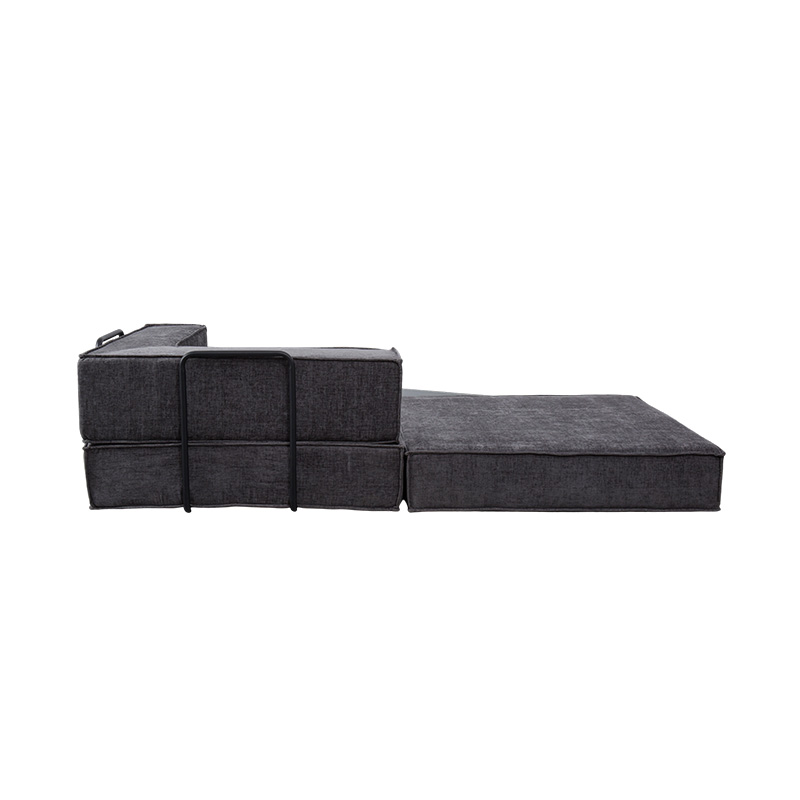 Creative Modular Sofa in Dark Gray Fabric, Freely Combinable and Multi-Functional Full-FoaDimensions: W98cm × D100cm × H70cm Foam: D28/60 Fabric: ChenilleView Product →
Open-plan family rooms
Larger rooms hand the work to the corner module: one corner plus four or five seat modules anchors the seating zone without blocking walkways, and darker corduroy or velvet upholstery hides daily wear far better than pale flat weaves.
Rooms that host overnight guests
Where the sofa doubles as a guest bed, choose a purpose-built transformable module rather than improvising with loose cushions. The seat surface pulls or folds flat into a sleeping area of roughly 190 by 120 centimeters, which comfortably fits most adults:
transformable modular sofa bed in dark gray corduroy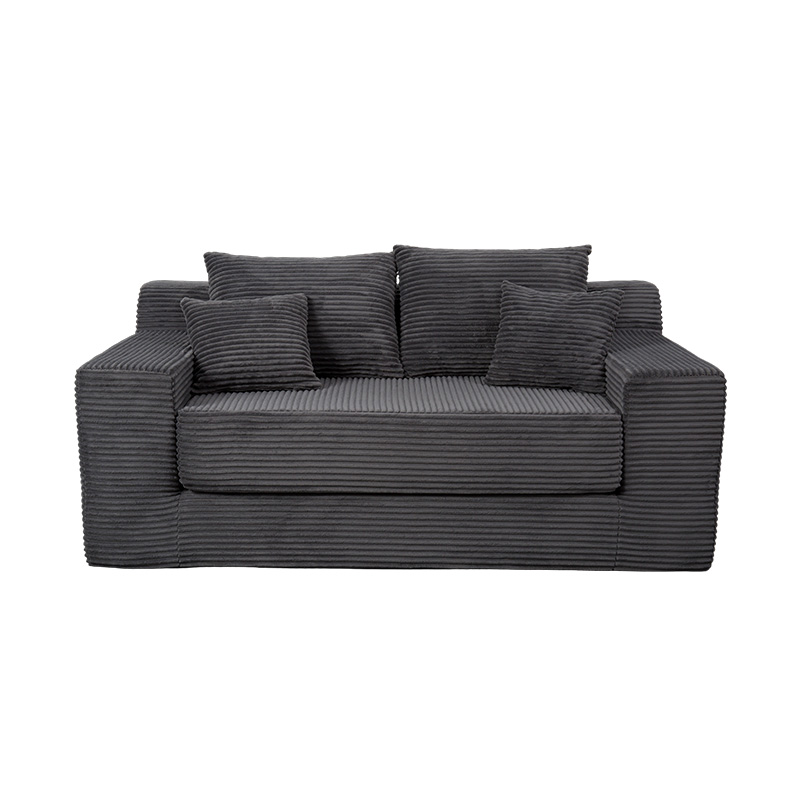 Transformable Modular Sofa Bed in Dark Gray Corduroy with Multiple CushionsDimensions: W172cm × D98.5cm × H85cm / W172cm × D162cm × H72cm Foam: D30/60 Fabric: CorduroyView Product →
Why Full-Foam Construction Pairs Well with Modular Design
Full-foam construction, in which each seat is a high-density foam block over a support structure with no zigzag springs or spring packs, suits modular engineering for three reasons. Each module is self-supporting, so comfort does not depend on how many modules happen to be joined. There are no springs to squeak and no tie wires to fatigue, which matters once modules are rearranged often. And box-shaped foam modules hold their geometry through repeated moves, so the gaps between modules stay even instead of wandering out of alignment.
This is why our modular ranges are built on full-foam platforms. The company operates a dedicated foam factory alongside its finished-furniture plant, which means seat firmness can be tuned during production instead of being accepted as a fixed specification, and buyers who need a particular width, depth, or fabric can order it directly, as explained in this overview of full-foam sofa manufacturer direct custom designs. The same construction extends across the wider full-foam sofa range, from single lounge modules to large corner arrangements. A representative deep blue configuration:
modular full-foam sofa set in deep blue corduroy with cushioned modules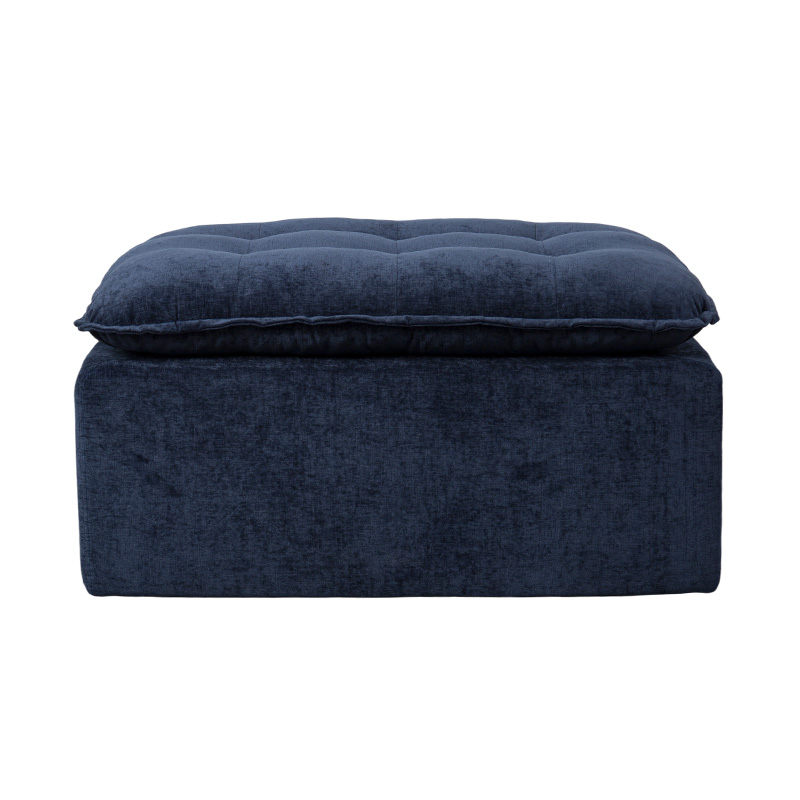 Deep Blue Full-Foam Modular Sofa Set with Matching OttomanA representative full-foam configuration pairing a 104.5 cm single sofa with a matching ottoman. D35 foam and chenille upholstery show how factory-made foam modules keep comfort consistent across custom widths, depths, and fabrics.View Product →
The decision comes down to four measurements and one honest question. Measure the narrowest door, stairwell, and elevator on the delivery path. Count the connectors and confirm they are steel rather than plastic. Check seat foam density in kilograms per cubic meter rather than trusting marketing words like comfortable. Decide which two or three layouts you will actually use. The question is whether your room will change within five years. If a move, a growing family, or a new home office is realistic, modular construction repays its premium in flexibility many times over. If the answer is a firm no, put the difference toward a higher-grade fixed frame instead, and revisit modular seating when your space next changes.