0

 English
 简体中文

Content
A sofa rarely dies from one accident. It dies at two contact points: the front edge where a dog pushes off to jump down, and the cushion crown where hair, grit and drool collect week after week.
That is the detail most pet-friendly marketing skips. Stain-guard sprays wash out, removable covers get laundered twice and then pushed to the back of a cupboard, and a cover that pills in month three was never going to survive year three. What actually decides whether a couch holds up in a house with two cats and a 30 kg retriever is measurable: the weave density of the cover, the density and structure of the foam beneath it, and whether a damaged section can be replaced on its own.
This guide follows the same order that pet damage appears in a living room, with the figures worth checking on a specification sheet before you pay.
What Makes a Couch Pet Friendly
A pet-friendly couch is one whose cover, filling and frame tolerate repeated claw contact, shed hair and wet accidents without lasting damage or a full replacement.
Four checkpoints decide that outcome, and each one should be answerable with a number or a plain yes:
- Cover weave and abrasion rating. A tight, short-fiber weave rated above roughly 25,000 double rubs resists claw snagging far better than a loose, looped or brushed surface.
- Foam structure. Full-foam seats keep their shape and leave no gaps where hair, crumbs and small toys disappear.
- Replaceable parts. Zipped covers, reversible cushions and modular seats turn a repair into a ten-minute job.
- Cleanability and color. A mid-tone cover in a washable fabric hides shed hair far better than cream linen or near-black velvet.
Fabric Choice: Rub Counts, Weave and Hair Pickup
A tight, high-rub-count weave with short fibers beats every pet-proof coating on the market, and it costs less to maintain over five years.
| Cover type | Double rubs | Hair pickup | Claw snag risk | Routine clean-up |
| Jacquard chenille | 30,000+ | Low | Low to moderate | Vacuum, blot spills |
| Ribbed corduroy | 20,000 to 30,000 | Moderate, traps in ribs | Low | Brush with the nap |
| Cotton velvet | 15,000 to 25,000 | High | High | Professional clean |
| Linen or basket weave | 12,000 to 20,000 | Low | High | Cover wash only |
| Teddy or faux sherpa | 15,000 to 20,000 | Very high | Moderate | Spot clean only |
| Faux leather (PU) | 25,000+ surface | Very low | Low, but punctures | Wipe with damp cloth |
Double rubs count how many back-and-forth abrasion cycles a fabric survives before showing wear. Anything above 25,000 sits in heavy domestic territory; below 15,000 the cover thins at the seat front long before the frame gives out. Hair pickup is a separate property and deserves more attention than it usually gets, because a fabric that grips hair turns a two-minute vacuum into a twenty-minute job.
Foam, Frame and the Parts Pets Break First
Foam density and full-foam construction decide whether a couch keeps its shape under claws and a 40 kg dog, and a spring deck is where most pet damage hides.
On a spring sofa, the deck fabric between coils collects hair and grit, and the gaps flex every time a pet lands. That is the source of the sagging dip in the middle seat and the faint smell vacuuming never fully removes. A full-foam seat replaces the assembly with a solid block, so load spreads across the cushion instead of concentrating on one coil, and there is no cavity underneath for debris to fall into.
Density is not the same as hardness. A 35D foam can feel soft; a 25D foam with a firm surface coating feels hard and still collapses within two years under a dog that sleeps in the same spot. Because the sponge is made in our own plant, density is fixed at the block stage rather than negotiated with a supplier after the covers are cut.
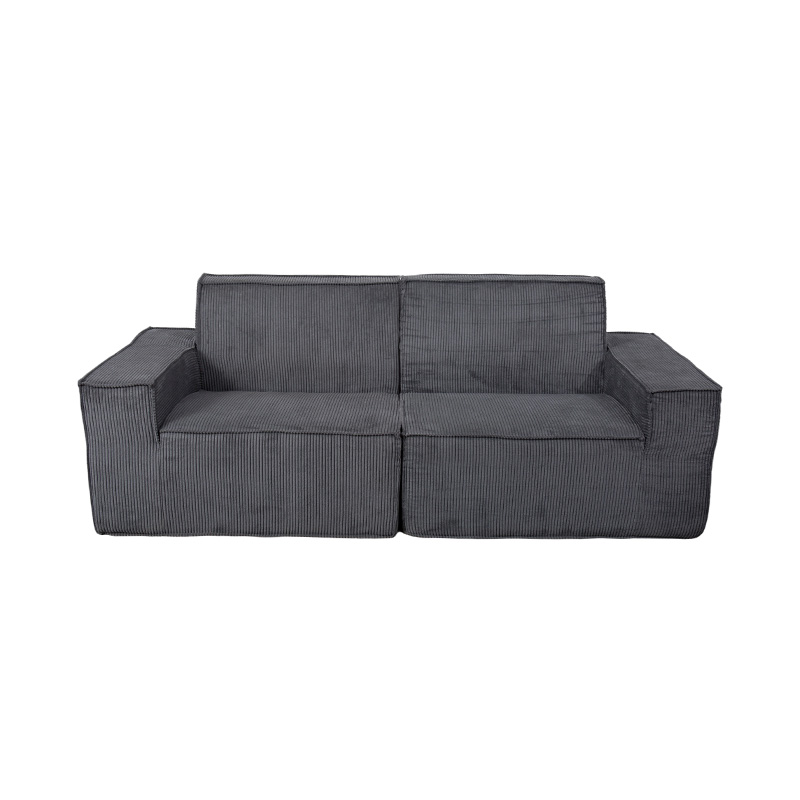
 Dark Gray Full-Foam 3–4 Seater SofaA frameless D35 full-foam sofa in dark gray jacquard chenille, offering medium-firm daily support and tool-free setup for low-hassle living rooms.View Product →
Modular Builds: Replace One Seat, Not the Sofa
Modular seating is the only category that lets you replace a single damaged module instead of the whole couch, which is why it wins on lifetime cost in pet households.
A cat that targets one arm of a sofa keeps targeting that arm. With a fixed frame, the result is a reupholstery quote or a new sofa. With a modular build, the arm module comes off and a replacement goes on.
- Measure the jump zone. Note where the pet launches from and lands; the seat front edge and the nearest arm take the most abrasion.
- Count modules for the pet's spot. A wider chaise or an extra seat module gives the animal a place that is not the walkway.
- Check the connectors. Metal brackets or interlocking bases should hold under a running landing, not just under a seated adult.
- Confirm spare covers exist. Ask whether single module covers can be ordered later in the same dye lot.
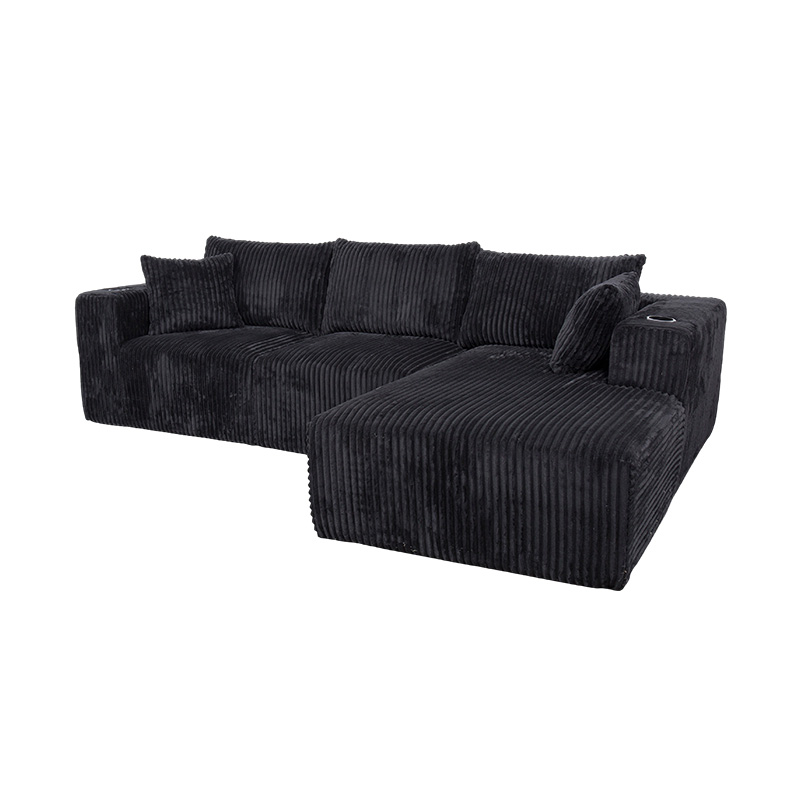
 Black Corduroy Modular L-Shaped Sofa with Cup HoldersA frameless modular full-foam corner sofa in black corduroy with D30/60 support, multiple cushions, built-in cup holders, and no assembly for flexible lounges.View Product →
Faux Leather or Fabric for Claws
Faux leather wipes clean and releases hair, while fabric feels warmer and hides surface scratches; the right answer depends on whether your pet sheds or scratches.
Faux leather wins when
- Your pet sheds heavily and hair shows on every fabric
- Accidents and muddy paws are a weekly event
- You prefer a wipe-down routine to a washing routine
Fabric wins when
- Your cat kneads and scratches, since woven covers snag rather than puncture
- The room needs warmth and sound absorption
- You want removable, washable covers with a longer service life
The trade-off is mechanical. Claws dragged across PU can leave a permanent puncture, while the same claws on a tight chenille lift a thread that can be trimmed back. A single muddy afternoon on a light fabric cover costs a wash cycle; the same afternoon on faux leather costs one wipe.
 Custom Patchwork Leather Sofa with Velvet CushionsA customizable patchwork leather sofa with light grey velvet cushions and leather armrests, offered in single or double sizes with color, material, and finish options.View Product →
A Pre-Purchase Checklist
Six checks catch nearly every pet-related sofa failure before payment, and all of them take under ten minutes.
- Ask for the abrasion rating in double rubs and reject anything under 20,000 for a pet household.
- Confirm seat foam density, ideally 35D or above, and ask whether the foam is one block or layered.
- Unzip a cover in the showroom and check that it comes off without dismantling the frame.
- Press a thumbnail into the seat front edge; soft, springy give means the foam is too light for daily claw contact.
- Choose a mid-tone color and a tight weave over pale linen or dark velvet.
- Ask what a replacement cover or module costs, and write the answer next to the sofa price.
For a deeper look at abrasion figures and how they interact with foam specification, our guide to rub counts and foam density in durable fabric sofas walks through the numbers.
Frequently Asked Questions
Is velvet a bad choice with cats?
Usually yes. Velvet has a raised pile that catches claws and holds hair, and it shows every pull mark. A tight jacquard chenille or a ribbed corduroy gives similar softness with far lower snag risk.
What foam density should I ask for?
35D or above for a seat used daily by people and pets. Below 30D, foam compresses permanently in the spot where a dog or cat sleeps, and the dip cannot be reversed by flipping the cushion.
Do washable covers actually hold up?
They do when the cover is a tight weave with a stable backing. Thin, loosely woven covers shrink and lose shape after several washes, so check whether replacement covers can be ordered in the original dye lot.
How often should a pet-household sofa be vacuumed?
Two to three times a week on the seat and once a week under the cushions. Loose hair abrades the weave from the inside every time someone sits down, and that wear shows long before the fabric itself fails.