 0
0

 English
 简体中文
简体中文

Content
- 1 Sofa Trends 2026: The Short Answer
- 2 Curved and Low Profiles: What the Silhouette Asks of a Factory
- 3 Modular Is No Longer a Niche Option, It Is the Default
- 4 Fabrics and Colours Buyers Are Specifying for 2026
- 5 Construction Details Worth Verifying Before You Order
- 6 What These Trends Mean for Importers and Own-Brand Buyers
- 7 Frequently Asked Questions
Seat heights are sliding toward 40 cm, arms are getting thinner, and most of the new sofa concepts moving through our sample room this year arrive as modules instead of one fixed frame. For anyone specifying, importing or manufacturing sofas in 2026, that shift is not cosmetic. Lower frames change how much foam fits inside a cushion, curved shells change packaging volume, and modular builds change how a container is loaded.
Sofa Trends 2026: The Short Answer
The dominant sofa trends for 2026 are curved organic silhouettes, low loungey profiles with deeper seats, modular and reconfigurable layouts, heavy surface texture in corduroy and boucle-type fabrics, warm earthy colour palettes, full-foam seat construction, and seating that stores or converts.
Those directions appear in retail catalogues and in factory order books at the same time. In practical terms, each one means the following:
- Curved silhouettes. Barrel arms, kidney chaises and eggshell enclosures have replaced the square three-seater as the reference shape.
- Lower seat heights. Most new designs sit between 38 and 42 cm, with a floor gap of 8 to 12 cm.
- Deeper seats. 58 to 64 cm is now normal where 52 to 55 cm was standard a few seasons ago.
- Modular construction. Armless, corner and chaise modules that can be reordered after delivery.
- Texture over pattern. Corduroy, chenille, teddy fleece, boucle and linen blends carry the visual weight instead of prints.
- Full-foam cores. Foam blocks are replacing spring units in seat cushions on comfort and sag-resistance grounds.
- Function built in. Storage footstools, foldable sofa beds and mobile pieces on castors.
Curved and Low Profiles: What the Silhouette Asks of a Factory
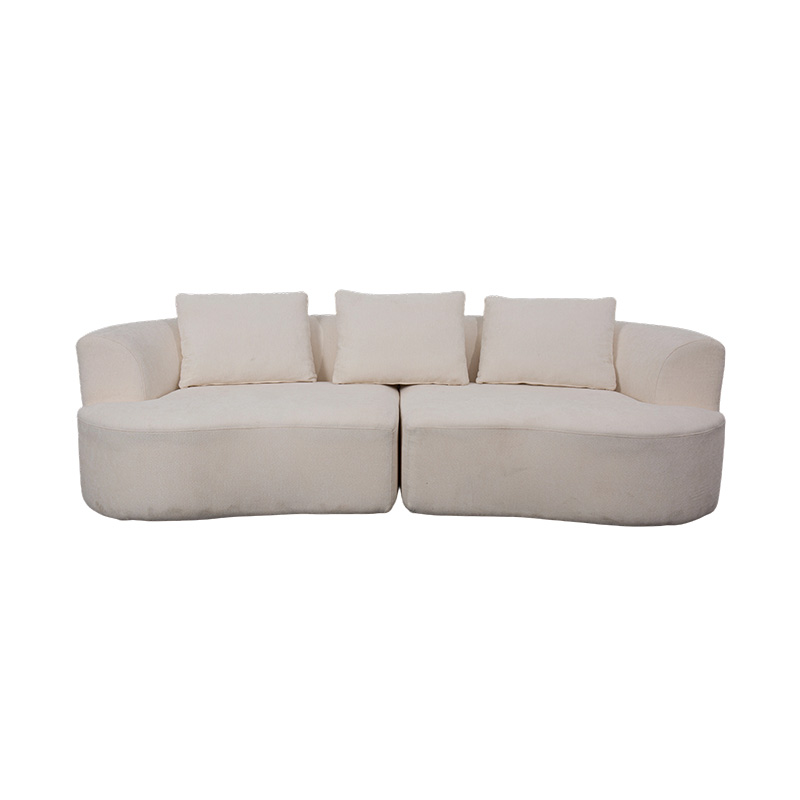
Curved shells and low profiles are the most visible 2026 change, and they are also the hardest to build well. A barrel arm, a kidney chaise or a fully enveloping eggshell seat removes the straight lines that normally hide seams, legs and joining hardware. Once the geometry curves, the frame has to change with it: bent plywood or laminated sections instead of straight hardwood rails, denser foam to hold a rounded edge, and tighter sewing tolerances so the curve reads as one continuous line rather than a series of panels.
Definition: a low-profile sofa is a seating unit with a seat height at or below 42 cm and a backrest under 75 cm. The visual mass drops toward the floor, the room reads taller, and the sofa stops competing with the architecture around it.
Deep seats only work with the right foam
A 62 cm seat depth feels generous until the cushion compresses. Deep, low seats spread more of the sitter's weight across a thinner profile, which is why so many 2026 designs abandon spring units. A full-foam core of roughly 28 to 35 kg/m3, topped with a softer 35 to 40 kg/m3 comfort layer, holds shape across the whole seat instead of loading a handful of coils. Get that specification wrong and the trend becomes a warranty claim within eighteen months.
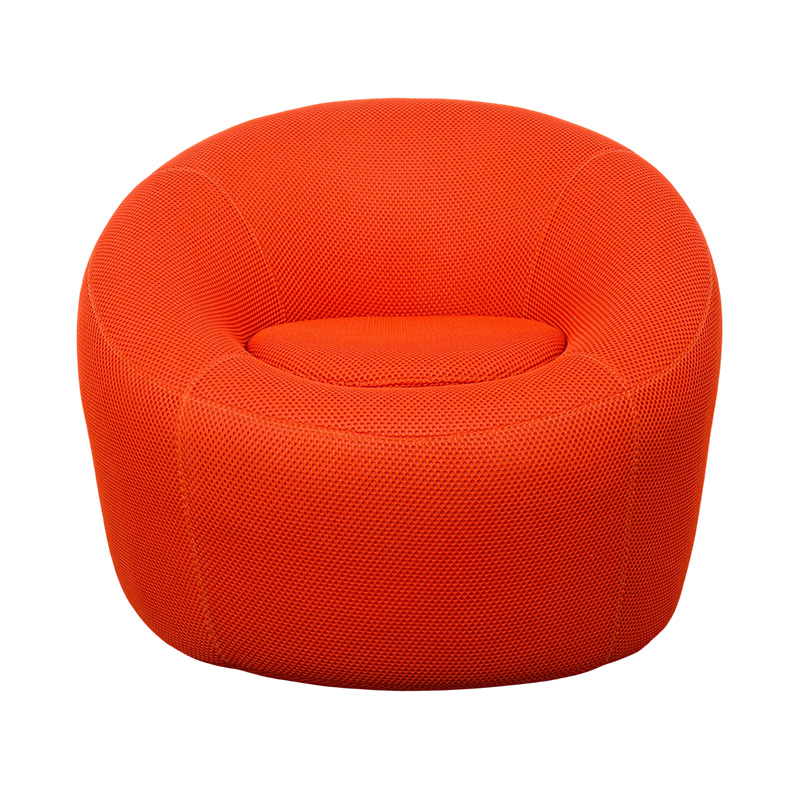 Single Full-Foam Eggshell-Shaped Enveloping Sofa with Breathable Mesh FabricA compact no-installation single sofa with D35 full-foam support and breathable sandwich fabric, suited to apartments, home offices and relaxed reading or working.View Product →
Modular Is No Longer a Niche Option, It Is the Default
Modular sofas became the default configuration in 2026 because they solve three commercial problems at once: tight rooms, tight stairwells and after-sale replacement.
Fixed-frame sofa
- Lowest unit cost and simplest quality control
- Cannot be reconfigured after delivery
- Often blocked by narrow stairs and small lifts
- Damage means replacing the whole unit
Modular sofa
- Two to five modules per set
- 8 to 14 percent higher unit cost
- Ships flat and assembles inside the room
- One module replaced instead of the sofa
The detail that decides whether a modular range survives its first year is boring but measurable. Module heights should match within two to three millimetres, or the seam line becomes visible across the whole set, and every connection point needs a load rating you can request in writing.
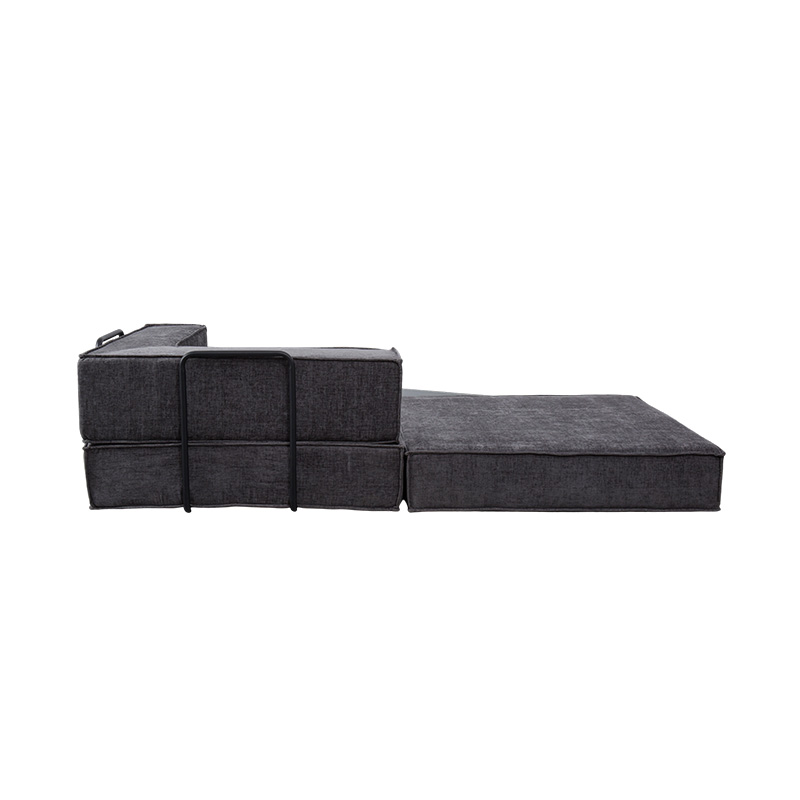 Dark Gray Creative Modular Sofa with Chenille UpholsteryA dark gray chenille modular sofa with D28/60 full-foam construction and no-installation setup, freely combinable for apartments, living rooms or family spaces.View Product →
Fabrics and Colours Buyers Are Specifying for 2026
Texture-led fabrics and warm earth tones dominate 2026 sofa requests. Corduroy and chenille are the two most requested textures, followed by teddy fleece, boucle and linen blends, while mushroom, mocha, caramel and olive green appear most often in colour submissions, with dusty pink, muted purple and rusty red filling the accent role.
| Colour family | Typical placement | Fabric that suits it | Practical note |
| Olive green | Feature sofas, lounge chairs | Chenille, velvet | Hides wear, pairs with wood floors |
| Mocha and mushroom | Full ranges, modular sets | Corduroy, teddy fleece | Warmest neutral and easiest to match |
| Caramel | Mid-range ranges | Chenille, linen blend | Shows soiling earlier in bright rooms |
| Rusty red | Statement pieces | Velvet, chenille | Small colour run, higher minimum risk |
| Dusty pink | Bedroom and secondary seating | Boucle, faux sherpa | Check light fastness before bulk |
| Navy and blue-green | Family lounges | Corduroy, linen blend | Reads as a neutral through 2026 |
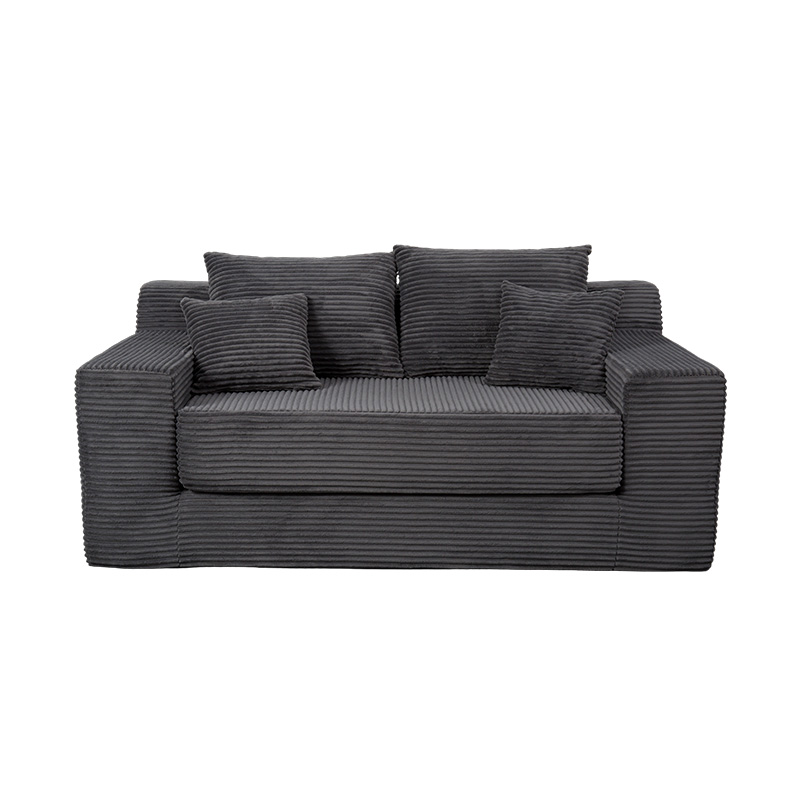
- Corduroy. A 3 to 5 mm wale hides scuffs and gives a low sofa a horizontal rhythm that flatters long silhouettes.
- Chenille. Soft and forgiving on curved arms, but it needs a tight backing to hold shape on deep seats.
- Boucle and teddy fleece. Excellent for wrapping rounded shells, though they show compression marks at fixed seating positions.
- Linen blends. The summer counterweight to heavy textures, best paired with removable covers on family pieces.
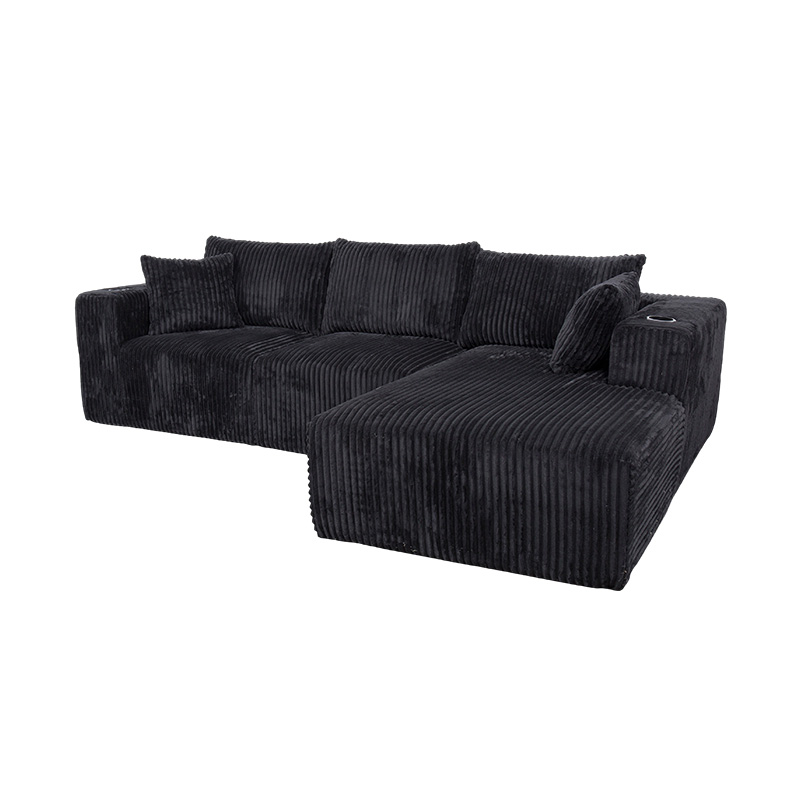
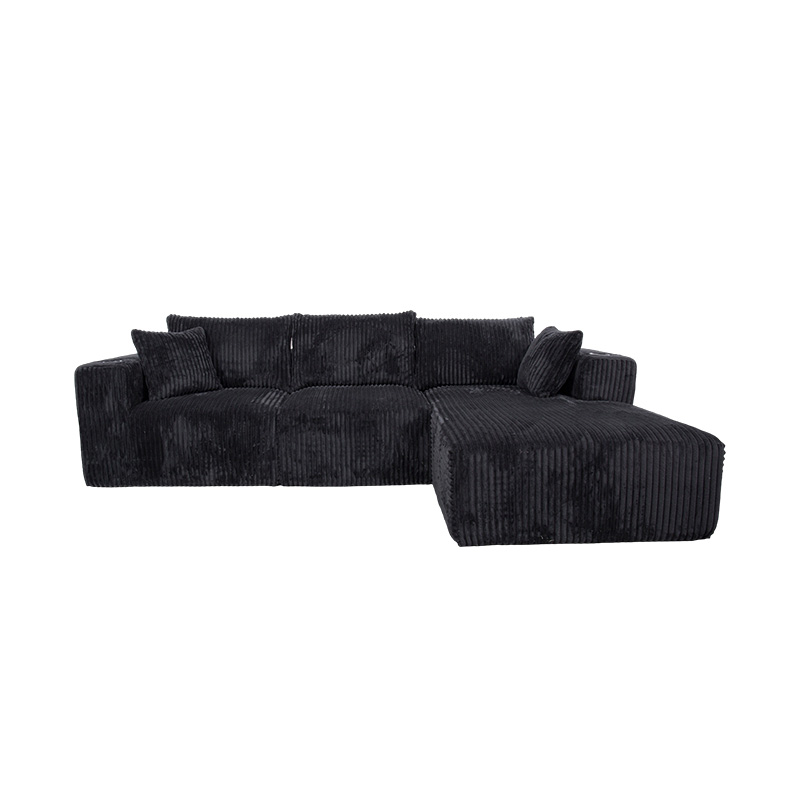 Large Black Corduroy L-Shaped Corner Sofa with Cup HoldersA custom L-shaped corner sofa with D30/60 full-foam modules, black corduroy upholstery, multiple cushions and built-in cup holders for living areas.View Product →
Construction Details Worth Verifying Before You Order
Full-foam seating, replaceable covers and storage-integrated frames carry the most quality risk in 2026, and all three are easy to disguise behind a good-looking sample.
- Foam density and layering. Ask for core and top-layer density in kg/m3 separately. One number tells you very little about how a deep cushion behaves after a year of use.
- Cover removability. Check zip access on seat and back cushions and whether the cover can be refitted without steaming. This is the difference between a five-year sofa and a fifteen-year frame.
- Frame and joint specification. Confirm hardwood, plywood or a mix, and request the static load rating of the modular joint instead of a general durability statement.
- Storage hardware. Gas struts and friction hinges behave differently under daily use, so ask for a cycle figure on any ottoman or storage bench lid.
- Packaging and loadability. Curved shells need moulded protection at the radius, and every extra module changes how many sets fit in a container.
Full-foam is not a label, it is a structure: the seat contains no spring unit at all. For a longer comparison of density, rebound and sag resistance against traditional springs, see our note on why full-foam sofas are replacing spring sofas in 2026.
What These Trends Mean for Importers and Own-Brand Buyers
Trend-led ranges usually fail on the supply side rather than the sales side. Curved shells cost more to pack, small colour runs push minimum order quantities up, and each extra module reduces the number of sets per container.
Because our own foam plant sits beside the finished goods line, density changes on a deep 2026 cushion can be tested and adjusted in days instead of across a supplier chain. If you are building a 2026 range that mixes full-foam modules, curved shells and storage footstools, contact our team with your drawings, dimensions and target price.
Frequently Asked Questions
Quick answer: for 2026, prioritise a low or curved silhouette in a textured earth-tone fabric, built on a full-foam core, and plan the layout in modules rather than one fixed frame.
What is the biggest sofa trend for 2026?
Curved, low-profile silhouettes are the most visible change, but modular construction has the longest commercial reach because it affects delivery, storage, replacement parts and room planning.
Are low-profile sofas comfortable for everyday use?
Yes, if the seat depth is paired with the right foam. A seat height of 38 to 42 cm with a 58 to 64 cm depth works well when the cushion uses a firmer core and a softer top layer instead of one soft block.
Which upholstery is most durable for a 2026 sofa?
For family use, tight-weave chenille, corduroy and linen blends with a synthetic component wear better than loose boucle. Texture hides everyday marks, but the backing structure matters more than the surface pattern.
Is modular better than a fixed sofa for small apartments?
Usually yes. Modules pass through narrow stairwells and lifts, can be rearranged when a room changes use, and a single damaged module can be replaced instead of the entire sofa.
Trends decide what a sofa looks like in the showroom, construction decides what it looks like in year three. Buy the silhouette you love, but specify the foam, the joint and the cover first.